
Fire Safety Signs FAQs
Written by the Technical Team at Caledonia Signs
Last reviewed: July 2026
Welcome to the Caledonia Signs Fire Signs Knowledge Centre
This Fire Safety Sign FAQs hub answers the most common questions about fire safety signage, including legal requirements, sign meanings, placement, maintenance, BS EN ISO 7010 standards, and workplace compliance. Whether you're carrying out a fire risk assessment, updating your premises, purchasing new fire safety signs, or simply looking for clear guidance, our expert answers will help you understand your responsibilities, improve fire safety, and choose the right signs for your workplace with confidence.
Fire safety signs play a vital role in protecting people, guiding emergency evacuations, and helping businesses comply with UK health and safety legislation. Whether you're responsible for an office, warehouse, factory, school, healthcare facility, retail premises, hospitality venue, or any other workplace, understanding which fire safety signs are required and how they should be used is essential for creating a safe environment. From fire exit signs and fire equipment signs to fire action notices and assembly point signs, choosing the correct signage helps ensure occupants can respond quickly and safely in an emergency.
In the UK, fire safety signage forms an important part of an effective fire safety strategy. Signs provide clear visual instructions that help people identify fire extinguishers, locate fire alarms, and understand the actions they should take if a fire occurs. They are particularly valuable in unfamiliar buildings, helping employees, visitors, and contractors find the safest way to evacuate while reducing confusion and panic during an emergency. Fire safety signs should always be clearly visible, easy to understand, and maintained in good condition to remain effective.
Why are fire safety signs important?
Fire safety signs are essential for helping people respond quickly and safely during a fire or other emergency. They provide clear visual instructions that identify fire extinguishers, fire-fighting equipment, fire alarm call points, and the actions occupants should take in the event of a fire. Well-positioned, easy-to-understand fire safety signs can reduce confusion, support a faster evacuation, and help minimise the risk of injury.In the UK, fire safety signs are often required where a fire risk assessment identifies that signage is necessary to warn, instruct or guide people. They should comply with recognised standards, such as ISO 7010, to ensure symbols are easily understood regardless of language or experience. Employers, building owners and those responsible for premises should ensure fire safety signs are correctly installed, clearly visible, well maintained, and kept up to date. By providing consistent and recognisable information, fire safety signs play an important role in improving workplace safety, supporting legal compliance, and protecting employees, visitors and members of the public.
What are the penalties for inadequate fire safety signage?
Failing to provide adequate fire safety signage can put people at risk and may lead to enforcement action if it results in non-compliance with UK fire safety legislation. Under the Regulatory Reform (Fire Safety) Order 2005, the responsible person must ensure that appropriate fire safety measures are in place, which may include the provision of suitable fire safety signs where identified by a fire risk assessment.If fire safety signage is missing, incorrect, poorly maintained or not clearly visible, enforcing authorities such as the local Fire and Rescue Service may issue an Alterations Notice, Enforcement Notice or Prohibition Notice requiring the issues to be addressed. In more serious cases, particularly where inadequate signage contributes to significant risks or places people in danger, prosecution may result. Courts can impose unlimited fines and, in the most serious offences, custodial sentences.
Beyond legal penalties, inadequate fire safety signage can delay evacuations, make it more difficult to locate fire-fighting equipment, increase the risk of injury, and expose organisations to civil claims, reputational damage and business disruption. Regular fire risk assessments, routine inspections and the correct use of compliant fire safety signs help ensure your premises remain safe and meet your legal responsibilities.
How do I choose the right fire safety signs for my building?
Choosing the right fire safety signs starts with carrying out a suitable fire risk assessment to identify the hazards, fire-fighting equipment and emergency procedures within your building. The type of premises, its layout, the number of occupants, and whether visitors or members of the public use the building will all influence the signage required. In many workplaces, you'll need a combination of fire equipment signs, fire action notices, fire door signs and fire warden / marshal signs to ensure people can quickly locate essential fire safety equipment during an emergency.Fire safety signs should comply with recognised standards, including ISO 7010, which uses internationally recognised symbols to improve understanding regardless of language. Signs should be positioned where they are easy to see, remain unobstructed, and be clearly visible under normal conditions and during an emergency. They should also be regularly inspected and replaced if they become damaged, faded or no longer reflect the building's layout or fire safety procedures.
If you're unsure which fire safety signs your premises require, consult your fire risk assessment or seek advice from a competent fire safety professional. Selecting the correct signs and displaying them in the right locations will help you meet your legal responsibilities, support a safe evacuation, and ensure employees, visitors and contractors can respond quickly and safely in the event of a fire.
Caledonia Signs Expert Tip: Focus on Visibility
One of the most common issues we see is that fire extinguisher and fire alarm signs are technically present but difficult to spot because they've been installed too low or have gradually become hidden behind furniture, shelving or equipment.
As a general guide, fire equipment identification signs are often positioned between 1.7 and 2.0 metres above floor level. Mounting signs at this height helps them remain visible even when the equipment itself is partially obscured, making it easier for people to locate essential fire-fighting equipment quickly in an emergency while supporting recognised installation best practice.
Whenever premises are refurbished, layouts are altered or storage arrangements change, it's worth reviewing both the fire equipment and its associated signage to ensure everything remains clearly visible, correctly positioned and easy to identify.
Can fire safety signs be photoluminescent (glow in the dark)?
Yes. Photoluminescent fire safety signs, often referred to as glow-in-the-dark signs, can be an excellent choice for helping people find escape routes and fire safety equipment if normal lighting fails. These signs absorb light from natural or artificial sources and then emit a visible glow in low-light or blackout conditions, making them particularly useful during emergency evacuations.Photoluminescent signs are commonly used for fire fighting equipment signs such as fire hose signs, fire alarm signs, fire extinguisher signs. While they can improve visibility during an emergency, they should not be seen as a substitute for emergency lighting where this is required. The need for emergency lighting and fire safety signage should always be determined through a fire risk assessment and in accordance with the relevant fire safety regulations and standards.
To remain effective, photoluminescent fire safety signs should be installed in locations where they receive sufficient ambient light to charge properly and should be kept clean, unobstructed and in good condition. Choosing high-quality signs that comply with recognised standards, such as ISO 7010, helps ensure they display clear, universally recognised symbols and provide reliable guidance when it's needed most.
Who is responsible for providing fire safety signage?
Responsibility for providing fire safety signage usually falls to the responsible person for a premises. This is typically the employer, building owner, landlord, occupier, or another person who has control of the building or responsibility for fire safety arrangements. Their duties include ensuring that suitable fire safety measures are in place, which may include providing appropriate fire safety signs where they are identified as necessary by a fire risk assessment.The responsible person must ensure that fire safety signs are suitable for the building, clearly visible, correctly positioned and maintained in good condition. This may include signs identifying fire extinguisher, fire alarm call points and fire action and emergency procedures. The type and number of signs required will depend on the size, layout, use and specific risks associated with the premises.
For rented or shared buildings, responsibility may be shared between different parties, such as landlords, tenants, managing agents and employers. It is important that roles are clearly defined to ensure there are no gaps in fire safety responsibilities. Regular reviews of fire risk assessments and fire safety arrangements will help ensure signage remains effective, up to date and suitable for everyone using the building.
Where should fire safety signs be displayed?
Fire safety signs should be displayed directly above, beside or close to fire-fighting equipment so that it can be quickly identified and accessed in an emergency. This includes equipment such as fire extinguishers, fire blankets, fire hose reels, fire alarm call points and other fire-fighting facilities. The purpose of these signs is to ensure that people can easily locate essential equipment, even if they are unfamiliar with the building.Signs should be positioned where they are clearly visible and not hidden by doors, furniture, stock, machinery or other obstructions. In larger buildings, busy workplaces or areas where equipment could be difficult to see, additional directional signs may be required to guide people towards fire-fighting equipment. The visibility of signs is especially important in locations such as warehouses, factories, offices, schools, healthcare facilities and retail premises where quick access to fire equipment may be critical.
Fire signs should use clear, recognised symbols and comply with relevant standards, such as ISO 7010, to ensure they are easily understood. They should also be regularly inspected to make sure they remain clean, undamaged and suitable for the environment. If the location of fire equipment changes, signage should be updated to reflect the new position.
Correctly displayed fire safety signs help people respond more effectively during a fire, reduce delays when locating fire-fighting equipment and support a well-managed fire safety system within any building.
Looking for Safety Signs?
Caledonia Signs is one of the UK's leading trade-only manufacturers of safety signage, supplying an extensive network of distributors throughout the UK and overseas. If you're an end user looking to purchase safety signs, we'd still be delighted to help. Simply contact us with details of your requirements and we'll be happy to recommend a suitable distributor in your area. Interested in becoming a distributor? Contact our team to discuss opening a trade account and gaining access to our full product range, trade pricing and online ordering portal.
Do fire safety signs need to comply with ISO 7010?
In the UK, fire safety signs should comply with BS EN ISO 7010, the British adoption of the international ISO 7010 standard. This standard specifies the graphical symbols, colours, shapes, and layouts used on safety signs to ensure they are easily recognised and understood by everyone, regardless of language or literacy.
BS EN ISO 7010 supports compliance with the Health and Safety (Safety Signs and Signals) Regulations 1996 and complements the requirements of the Regulatory Reform (Fire Safety) Order 2005, which requires responsible persons to provide appropriate fire safety information where necessary. Using standardised signs helps ensure consistency throughout a building and improves the effectiveness of emergency procedures.
Fire safety signs covered by BS EN ISO 7010 include those identifying fire extinguishers, fire blankets, fire hose reels and fire alarm call points. These signs use standardised pictograms and colour schemes, such as white symbols on a red background for fire-fighting equipment and white symbols on a green background for safe condition and escape route signs.
When installing new signage or replacing existing signs, organisations should use BS EN ISO 7010-compliant signs to ensure they meet current UK best practice. Signs should be clearly visible, correctly positioned, adequately illuminated where necessary, and maintained in good condition so they remain effective in an emergency.
What fire safety signs are required in a workplace?
In UK workplaces, fire equipment signs are required to clearly identify the location of fire-fighting equipment so that it can be found quickly in an emergency. These signs should comply with BS EN ISO 7010 and be positioned directly above or adjacent to the equipment so that it remains visible, even if the equipment is temporarily obstructed.
Fire extinguisher signs are used to indicate the location of extinguishers and, where appropriate, identify the type of extinguisher provided, such as water, foam, CO₂, dry powder, or wet chemical. Many workplaces also display an identification sign or information panel above the extinguisher, explaining the classes of fire it is suitable for and any hazards associated with its use.
Manual fire alarm call points should be identified with the appropriate BS EN ISO 7010 fire alarm sign to enable occupants to quickly locate and operate them in the event of a fire. These signs are typically positioned directly above the call point to ensure they are easily visible.
Other fire-fighting equipment, including fire hose reels, fire blankets, dry riser inlets and outlets, sprinkler control valves, and fire mains, should also be clearly identified using the relevant BS EN ISO 7010 signs where provided. Appropriate signage ensures that both building occupants and the fire and rescue service can quickly locate essential equipment during an emergency.
All fire equipment signs should use the standard red background with a white pictogram specified by BS EN ISO 7010. They should be clearly visible, unobstructed, and maintained in good condition to ensure they remain effective throughout the life of the building.
Are fire safety signs a legal requirement in the UK?
Yes, fire safety signs are a legal requirement in the UK where they are necessary to protect building occupants and support safe evacuation. The requirement is set out in the Regulatory Reform (Fire Safety) Order 2005, which places a duty on the responsible person to provide appropriate fire safety measures, including signage where required. In addition, the Health and Safety (Safety Signs and Signals) Regulations 1996 require safety signs to be provided where a risk cannot be adequately controlled by other means.
Fire safety signs are used to identify the location of fire-fighting equipment, such as fire extinguishers, fire alarm call points, fire hose reels, and fire blankets, as well as to indicate emergency escape routes and fire exits. Their purpose is to enable occupants to quickly locate fire safety equipment and evacuate the building safely during an emergency.
Although the legislation does not explicitly state that signs must comply with BS EN ISO 7010, this standard is recognised as the accepted best practice in the UK. Using BS EN ISO 7010 compliant signs helps demonstrate compliance with legal requirements by providing clear, consistent, and universally recognised symbols that can be understood regardless of language.
The type and extent of fire safety signage required should always be determined by the building's fire risk assessment. The responsible person must ensure that signs are appropriate for the premises, clearly visible, correctly positioned, and maintained in good condition so they remain effective when needed.
Caledonia Signs Expert Tip: Include Signs in your Routine Safety Checks
Regularly inspect your fire safety signs as part of your routine fire safety checks. Replace any signs that are damaged, faded, missing, or no longer reflect the building layout or fire equipment locations. Clear, accurate signage is essential to help people respond quickly and safely in an emergency.
How often should fire safety signs be checked or maintained?
Fire safety signs should be inspected regularly to ensure they remain clearly visible, legible, securely fixed, and in good condition. Although UK fire safety legislation does not specify a fixed inspection frequency, signs should be included as part of routine workplace safety inspections and the building's fire safety maintenance programme.
During inspections, check that signs are not damaged, faded, dirty, or obstructed by furniture, equipment, decorations, or stored materials. Fire equipment signs should still clearly identify the location of fire extinguishers, fire alarm call points, fire blankets, and other fire-fighting equipment, while emergency escape route signs should remain visible from all relevant approaches.
Fire safety signs should also be reviewed whenever there are changes to the building, fire risk assessment, escape routes, or the location of fire-fighting equipment. Any missing, incorrect, or damaged signs should be replaced promptly with BS EN ISO 7010 compliant signage to ensure occupants can easily identify fire safety equipment and evacuation routes in an emergency.
What size should fire safety signs be?
There is no single legally required size for fire safety signs in the UK. Instead, signs should be large enough to be clearly visible and easily understood from the distance at which they need to be seen. The appropriate size will depend on factors such as the viewing distance, mounting height, lighting conditions, and the location of the sign within the building.
For fire equipment signs, such as those identifying fire extinguishers, fire alarm call points, fire blankets, and fire hose reels, a 150 × 200 mm sign is commonly used when mounted directly above the equipment. This provides sufficient space for both the fire equipment symbol and, where applicable, additional information about the type of extinguisher or equipment.
A 100 × 100 mm fire equipment sign is commonly installed at the top of a wall directly above the equipment. Positioned at a higher level, it remains visible even if the equipment is temporarily obscured by people, furniture, or other objects, making it easier for occupants and the fire and rescue service to quickly locate fire-fighting equipment during an emergency.
When selecting sign sizes, employers should ensure the signs comply with BS EN ISO 7010, are appropriate for the viewing distance, and are positioned so they remain clearly visible at all times. The exact size and placement should always be suitable for the building layout and the intended viewing distance.
What are the latest UK regulations for fire safety signs?
There have been no recent changes to UK legislation that specifically alter the legal requirements for fire safety signs. The principal legislation remains the Regulatory Reform (Fire Safety) Order 2005 and the Health and Safety (Safety Signs and Signals) Regulations 1996, which require appropriate fire safety signage to be provided where it is necessary to reduce risk and assist with emergency evacuation.
Current UK best practice is to use signs that comply with BS EN ISO 7010, which standardises the design, colours, shapes, and graphical symbols used on fire safety signs. The standard is regularly updated to incorporate new or revised safety symbols, with the latest published edition being BS EN ISO 7010:2020+A8:2024. Using compliant signage helps ensure fire safety signs are clear, consistent, and easily understood regardless of language.
Fire equipment signs should clearly identify the location of fire extinguishers, fire alarm call points, fire blankets, fire hose reels, and other fire-fighting equipment. Signs should be positioned so they remain visible at all times, even if the equipment is temporarily obscured, and should be maintained in good condition throughout the life of the building.
Although compliance with BS EN ISO 7010 is not explicitly mandated in legislation, it is the recognised standard used throughout the UK to demonstrate good practice and support compliance with fire safety and workplace health and safety requirements. Organisations installing new signs or replacing existing signage should therefore use BS EN ISO 7010 compliant products wherever possible.
Caledonia Signs Expert Tip: Redirect to New Locations
Update fire safety signs when moving or replacing fire-fighting equipment. If a fire extinguisher, fire blanket, or alarm call point is relocated, update the signage immediately so it accurately identifies the equipment's new location and avoids confusion during an emergency.
Do landlords need fire safety signs?
Whether a landlord is required to provide fire safety signs depends on the type of property and the findings of the fire risk assessment. In the UK, under the Regulatory Reform (Fire Safety) Order 2005, landlords or other responsible persons for the common areas of multi-occupied residential buildings have a legal duty to provide appropriate fire safety measures, including signage where it is necessary to protect residents and visitors.
In blocks of flats, houses in multiple occupation (HMOs), and other multi-occupied buildings, fire safety signs are commonly required to identify fire exits, escape routes, fire doors, fire alarm call points, and fire-fighting equipment such as fire extinguishers and fire blankets. The need for signage should be determined through a suitable and sufficient fire risk assessment.
For single-family homes and most privately rented dwellings occupied by a single household, fire safety signs are not generally a legal requirement. However, landlords must still comply with other fire safety obligations, such as providing working smoke alarms and, where required, carbon monoxide alarms.
Where fire safety signs are needed, it is considered best practice to use BS EN ISO 7010 compliant signage. Signs should be clearly visible, correctly positioned, and maintained in good condition to ensure they remain effective in an emergency.
What colour are fire safety signs?
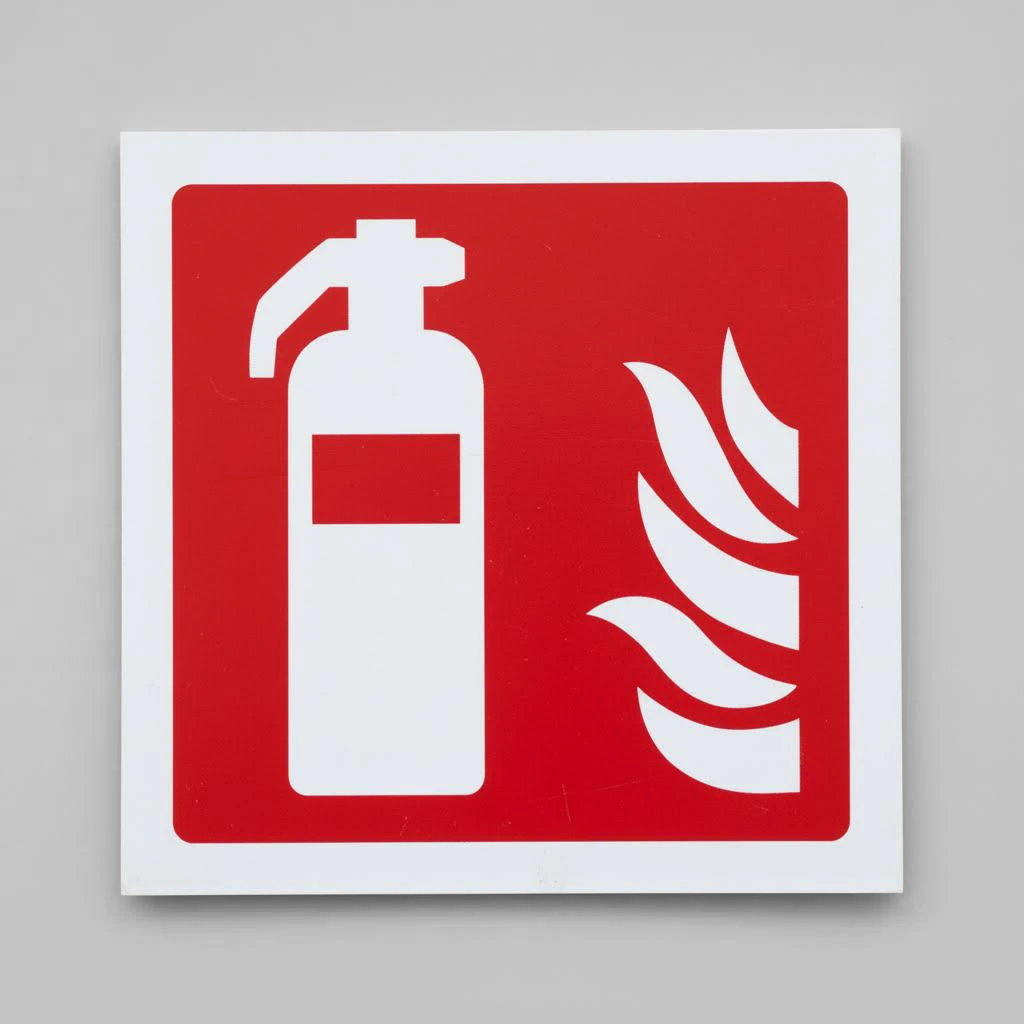
Fire equipment signs in the UK are red with white symbols in accordance with BS EN ISO 7010. The red background indicates the location of fire-fighting equipment, while the white pictogram enables the equipment to be quickly identified during an emergency.
These signs are used to identify the location of fire extinguishers, manual fire alarm call points, fire hose reels, fire blankets, dry riser inlets and outlets, sprinkler controls, and other fire-fighting equipment. The standardised colours and symbols ensure the signs are easily recognised and understood, regardless of language or experience.
Fire equipment signs are typically square or rectangular in shape and should be positioned directly above or adjacent to the equipment. In some cases, an additional high-level sign may be installed above the equipment to ensure it remains visible if the equipment is temporarily obscured by people, furniture, or other objects.
Using red and white BS EN ISO 7010 compliant signs helps provide a consistent approach to fire safety signage and supports compliance with UK fire safety best practice.
Do temporary workplaces need fire safety signs?
Yes, temporary workplaces may need fire safety signs if they are necessary to protect workers and other occupants. In the UK, the requirement for fire safety signage is based on the level of risk rather than whether the workplace is permanent or temporary. Employers and those responsible for the premises must ensure that appropriate fire safety measures, including signage where required, are provided.
Temporary workplaces such as construction sites, site offices, portable cabins, event structures, temporary warehouses, and pop-up premises should display fire equipment signs where fire-fighting equipment is provided. This includes signs identifying fire extinguishers, fire alarm call points, fire blankets, and other fire safety equipment, helping occupants locate them quickly in an emergency.
Where emergency escape routes and fire exits are provided, they should also be clearly identified with appropriate signage if they are not obvious. The need for fire safety signs should always be determined by a suitable and sufficient fire risk assessment, taking into account the layout of the workplace, the number of occupants, and the fire hazards present.
As with permanent workplaces, it is considered best practice to use BS EN ISO 7010 compliant fire safety signs. Signs should be clearly visible, securely fixed, and maintained throughout the duration of the temporary workplace to ensure they remain effective.
Caledonia Signs Expert Tip: Don't try to hide Equipment / Safety Signs
Don’t place storage, furniture, or decorations in front of fire equipment signs. A clearly visible sign is only effective if people can immediately identify the location of the fire-fighting equipment during an emergency.
When are fire action notices required?
Fire action notices are required in UK workplaces and other non-domestic premises where occupants need clear instructions on what to do in the event of a fire. Although there is no legal requirement stating that every building must display fire action notices, the Regulatory Reform (Fire Safety) Order 2005 requires the responsible person to provide appropriate fire safety information and instructions where necessary to ensure the safety of relevant persons.
Fire action notices are particularly important in workplaces, multi-occupied buildings, public buildings, schools, healthcare premises, hotels, and houses in multiple occupation (HMOs), where visitors or occupants may be unfamiliar with the building's fire procedures. They provide simple instructions on how to raise the alarm, evacuate safely, report the fire, and where to assemble after leaving the building.
Fire action notices are typically displayed next to manual fire alarm call points, near building entrances and exits, in reception areas, communal corridors, and other prominent locations where they can be easily seen. They should reflect the building's specific fire emergency procedures and be updated whenever evacuation arrangements or emergency contact details change.
To ensure consistency and clarity, fire action notices should use BS EN ISO 7010 compliant symbols where appropriate and be kept clean, legible, and in good condition. Their content should always align with the findings of the building's fire risk assessment and emergency plan.
What signs are required near fire extinguishers?
Fire extinguishers should be identified with a BS EN ISO 7010 compliant fire equipment sign positioned directly above the extinguisher so it can be easily located in an emergency. The sign should use the standard white fire extinguisher pictogram on a red background to clearly indicate the location of the equipment.
Where appropriate, an extinguisher identification sign should also indicate the type of extinguisher provided, such as water, foam, CO₂, dry powder, or wet chemical. Many organisations also include information on the classes of fire the extinguisher is suitable for and any important usage warnings, helping users select the correct extinguisher during an emergency.
In addition to the sign positioned above the extinguisher, it is common practice to install a 100 × 100 mm fire equipment sign at high level, such as at the top of the wall. This ensures the extinguisher's location remains visible from a distance, even if the equipment is temporarily obscured by people, furniture, or stored items.
All fire extinguisher signs should comply with BS EN ISO 7010, be clearly visible, securely fixed, and maintained in good condition. The exact signage requirements should reflect the building's fire risk assessment and the type of fire-fighting equipment provided.
What are the penalties for missing fire safety signage?
In the UK, there is no specific fixed penalty solely for missing fire safety signs. However, failing to provide appropriate fire safety signage where it is required can result in enforcement action under the Regulatory Reform (Fire Safety) Order 2005 and the Health and Safety (Safety Signs and Signals) Regulations 1996.
If a fire and rescue authority identifies inadequate fire safety signage during an inspection, it may issue an informal notice, require improvements through an enforcement notice, or, in serious cases where there is a significant risk to life, issue a prohibition notice preventing the use of part or all of the premises until the risk is addressed.
Non-compliance with fire safety legislation can also lead to prosecution. The courts can impose substantial fines, and in the most serious cases, individuals responsible for fire safety failures may face imprisonment. Penalties depend on the severity of the breach, the level of risk created, and whether there has been a failure to take reasonably practicable steps to protect people.
Maintaining clear, correctly positioned BS EN ISO 7010 fire equipment signs is a simple but important part of demonstrating effective fire safety management. Missing, damaged, or unclear signage should be identified through routine inspections and corrected promptly to ensure fire-fighting equipment can be located quickly in an emergency.
Caledonia Signs Expert Tip: Do they Match?
Make sure fire equipment signs clearly identify the correct type of fire-fighting equipment provided. Using the wrong type of fire extinguisher on an unsuitable fire can be dangerous and, in some cases, life-threatening. Always ensure signage clearly indicates the correct fire-fighting equipment to use for the risks present.
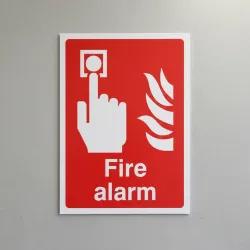
Fire Alarm Safety Signs
The Fire Alarm safety sign is vital for quickly guiding people to the location of the fire alarm system in case of an emergency. In a fire situation, ..
Symbol: ISO 7010: F005 - Fire Alarm Call Point Safety Signs
Catalogue Page: 9 (EDITION 26)
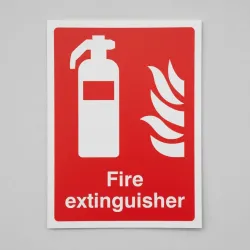
Fire Extinguisher Safety Signs
Fire Extinguisher safety signs are essential for ensuring that fire extinguishers can be quickly and easily located in an emergency. These signs are u..
Symbol: ISO 7010: F001 - Fire Extinguisher Safety Signs
Catalogue Page: 7 (EDITION 26)
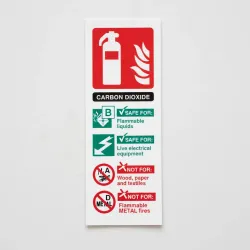
CO2 Carbon Dioxide Fire Extinguisher Identification Safety Signs
CO2 (Carbon Dioxide) Extinguisher Identification Signs are important because they clearly indicate the presence and proper use of CO2 fire extinguishe..
Symbol: ISO 7010: F001 - Fire Extinguisher Safety Signs
Catalogue Page: 6 (EDITION 26)
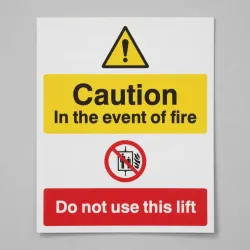
Caution - in the Event of Fire - Do Not Use this Lift Safety Signs
A Caution: In the Event of Fire, Do Not Use This Lift- safety sign is a critical component of building fire safety, providing a clear warning that ele..
Symbol: ISO 7010: W001 - General Warning Safety Signs
Catalogue Page: 15 (EDITION 26)
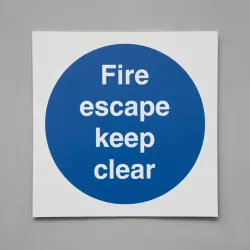
Fire Escape Keep Clear Safety Signs
A Fire Escape Keep Clear Door Sign is important because it ensures that designated emergency exits remain unobstructed at all times. Fire escape route..
Symbol: BS 5499-5: Fire Door Safety Signs
Catalogue Page: 11 (EDITION 26)
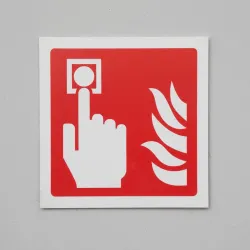
Fire Alarm Call Point Symbol Safety Signs
A Fire Alarm Call Point Symbol is used to clearly mark the location of a manual fire alarm activation point - often a red box with a glass or plastic ..
Symbol: ISO 7010: F005 - Fire Alarm Call Point Safety Signs
Catalogue Page: 9 (EDITION 26)
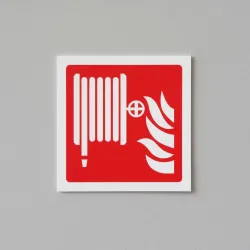
Fire Hose Symbol Safety Signs
A Fire Hose Symbol sign is used to clearly identify the location of a fire hose reel, helping people quickly find and access it in the event of a fire..
Symbol: ISO 7010: F002 - Fire Hose Safety Signs
Catalogue Page: 8 (EDITION 26)
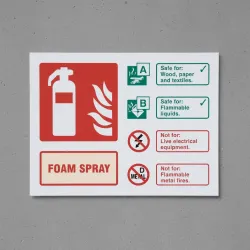
Foam Spray Fire Extinguisher Identification Sign (AFFF) Safety Signs
An AFFF Foam Spray Extinguisher sign plays a crucial role in fire safety by clearly indicating the presence and location of a foam fire extinguisher. ..
Symbol: ISO 7010: F001 - Fire Extinguisher Safety Signs
Catalogue Page: 6 (EDITION 26)