
Factories & Warehouse Signs FAQs
Written by the Technical Team at Caledonia Signs
Last reviewed: July 2026
Welcome to the Caledonia Signs Security and CCTV Signs Knowledge Centre
Effective factory and warehouse safety signage plays a vital role in creating a safe, organised, and efficient working environment. Industrial workplaces often contain a wide range of hazards, including moving vehicles, machinery, hazardous substances, storage areas, and pedestrian traffic routes. Clear safety signs and floor markings help employees, contractors, and visitors understand risks, follow workplace rules, and move safely around the site.
Choosing the right safety signs for a factory or warehouse can involve many considerations, from understanding UK regulations and ISO 7010 standards to deciding where signs should be installed and how they should be maintained. Factors such as visibility, sign placement, materials, floor demarcation, and the specific risks present within the workplace all play an important role in ensuring safety information is communicated effectively.
This page answers some of the most frequently asked questions about factory and warehouse safety signs, including legal requirements, inspection and maintenance guidance, improving signage visibility, floor marking best practices, and the importance of compliant safety communication. Whether you manage a warehouse, distribution centre, manufacturing facility, or industrial site, this guide provides practical information to help you create a safer and more efficient workplace.
Well-designed safety signage is an essential part of a wider health and safety strategy that includes risk assessments, employee training, and safe working procedures. From hazard warnings and mandatory PPE signs to fire safety, first aid, and traffic management signage, the right solutions help reduce confusion, improve awareness, and support a safer working environment for everyone on site.
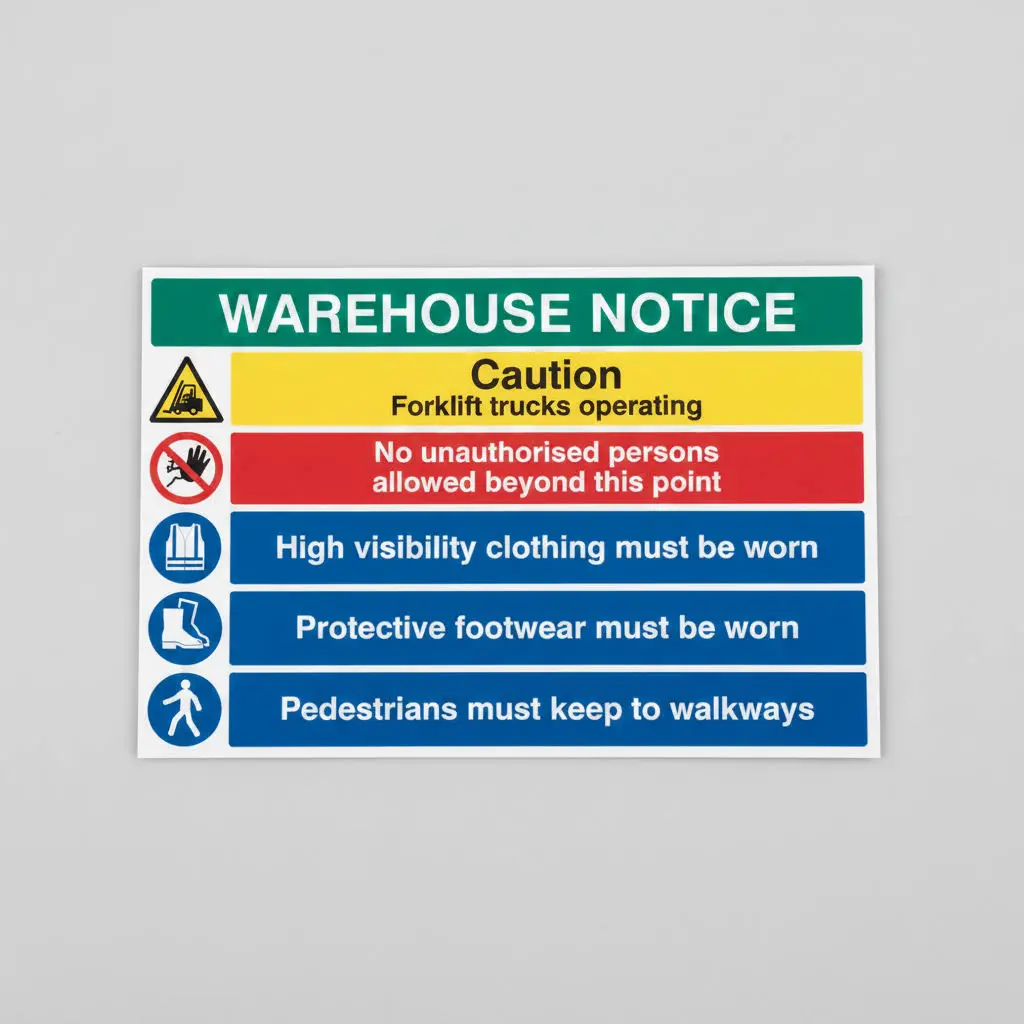
What safety signs are required in factories and warehouses?
Factories and warehouses require a range of safety signs to help identify hazards, communicate workplace rules, and guide employees, visitors, and contractors safely around the site. The exact signs required will depend on the activities carried out, the risks identified in the workplace risk assessment, and the layout of the building. Effective safety signage supports existing control measures by providing clear visual warnings and instructions where hazards cannot be eliminated.
Common safety signs used in factories and warehouses include warning signs for hazards such as forklifts, moving machinery, electrical risks, hazardous substances, and areas with restricted access. Mandatory signs are also widely used to indicate required personal protective equipment (PPE), such as safety footwear, eye protection, hearing protection, or high-visibility clothing. Prohibition signs communicate actions that are not allowed, such as no smoking, no entry, or no unauthorised access.
Emergency and welfare signage is also essential in industrial environments. This includes fire safety signs showing fire exits, escape routes, fire extinguishers, and fire alarm points, as well as first aid signs identifying first aid kits, first aid rooms, defibrillators, and emergency equipment. In areas where lighting may fail, photoluminescent safety signs can help maintain visibility of escape routes and emergency facilities.
In the UK, workplace safety signs should follow the requirements of the Health and Safety (Safety Signs and Signals) Regulations 1996 and use recognised symbols such as those outlined in BS EN ISO 7010. Employers should regularly review their signage as part of their health and safety management system to ensure signs remain visible, accurate, and appropriate for current workplace risks. Choosing the correct combination of safety signs helps factories and warehouses create safer working environments and improve communication of essential safety information.
Why are safety signs and floor demarcation important in warehouses?
Safety signs and floor demarcation are important in warehouses because they help create a safer, more organised working environment where employees, visitors, and vehicle operators can clearly understand potential hazards, movement routes, and workplace rules. Warehouses often contain a combination of pedestrian traffic, forklift operations, storage areas, loading zones, and machinery, making clear visual communication essential for preventing accidents and improving site efficiency.
Floor demarcation uses coloured lines, markings, and designated zones to clearly define areas such as pedestrian walkways, forklift routes, loading bays, storage locations, hazardous areas, and emergency access routes. By separating people from vehicles and identifying safe operating areas, floor markings help reduce the risk of collisions, trips, and unauthorised access while improving overall warehouse organisation.
Safety signs provide additional information by warning of hazards, highlighting mandatory PPE requirements, identifying emergency equipment, and communicating important workplace rules. Signs such as forklift warning signs, fire exit signs, first aid signs, and PPE requirement signs help employees and visitors quickly understand what actions are required and where safety facilities are located.
In the UK, effective warehouse signage and floor marking should support the requirements of workplace health and safety legislation, including the Health and Safety (Safety Signs and Signals) Regulations 1996. When combined with training, risk assessments, and safe working procedures, clear safety signs and floor demarcation help improve hazard awareness, support compliance, and create a safer and more efficient warehouse environment.
What are the penalties for inadequate warehouse safety signage?
Inadequate warehouse safety signage can result in enforcement action, fines, and legal consequences if it contributes to unsafe working conditions or increases the risk of injury. In the UK, employers have a legal duty to protect workers and visitors by managing workplace risks and providing appropriate safety information, including suitable signage where hazards cannot be controlled by other measures. Failure to meet these responsibilities can lead to action from the Health and Safety Executive (HSE) or other relevant enforcing authorities.
Under the Health and Safety at Work etc. Act 1974, businesses can face significant penalties for serious health and safety breaches. If inadequate signage contributes to an accident or exposes workers to unnecessary risk, the company may receive an improvement notice requiring corrective action, or a prohibition notice preventing certain activities from continuing until safety issues are addressed. Serious breaches can also result in prosecution, with fines imposed based on the severity of the offence.
Poor warehouse signage can also contribute to accidents involving forklifts, pedestrians, machinery, hazardous substances, or emergency situations. Where missing, unclear, or incorrect signs prevent people from recognising hazards or following safe procedures, businesses may face additional costs, including compensation claims, operational disruption, increased insurance costs, and damage to their reputation.
To reduce these risks, warehouses should regularly review their safety signage as part of their overall health and safety management system. Using clear, correctly positioned signs that follow recognised standards such as BS EN ISO 7010, alongside effective floor demarcation and employee training, helps improve hazard awareness and supports compliance with UK workplace safety requirements.
Caledonia Signs Expert Tip: Signs & Floor Markings for Warehouse Control
Safety signs are most effective when combined with clear floor demarcation to create a well-organised and easy-to-navigate workplace. Use signs and markings together to identify pedestrian walkways, forklift routes, loading areas, storage zones, hazardous areas, and emergency access points. This helps employees and visitors understand where they can safely move and what precautions they need to follow.
Regularly review your warehouse or factory layout and update signage whenever there are changes to equipment, processes, storage areas, or traffic routes. Ensure signs are positioned at eye level, kept clean, and remain visible at all times. A well-planned safety signage system not only helps reduce accidents but also improves efficiency, supports compliance, and creates a safer working environment for everyone on site.
How often should warehouse safety signs and floor markings be inspected?
Warehouse safety signs and floor markings should be inspected regularly to ensure they remain clear, visible, and effective. There is no single legal inspection interval specified for all safety signs in the UK, but employers have a responsibility to maintain a safe working environment and ensure that safety information remains suitable and understandable. Regular checks should form part of the workplace health and safety management system.
Many businesses carry out visual inspections of safety signs and floor markings as part of routine workplace checks, such as weekly, monthly, or scheduled safety inspections depending on the level of risk and activity within the warehouse. High-traffic areas, forklift routes, loading bays, and locations exposed to damage or wear may require more frequent checks due to the increased likelihood of signs becoming damaged, obscured, or less visible.
During inspections, check that signs are correctly positioned, clean, securely fixed, and still relevant to the current warehouse layout and activities. Floor markings should be checked for fading, peeling, damage, or obstruction, particularly in areas exposed to forklift movements, heavy foot traffic, chemicals, or cleaning processes. Any damaged or unclear signage should be repaired or replaced promptly.
Regular maintenance of warehouse safety signs and floor demarcation helps support compliance with the Health and Safety (Safety Signs and Signals) Regulations 1996 and recognised safety practices. By keeping safety communication clear and up to date, businesses can improve hazard awareness, reduce confusion, and help create a safer environment for employees, contractors, and visitors.
Do factory and warehouse safety signs need to comply with UK regulations and ISO 7010?
Yes, factory and warehouse safety signs should comply with relevant UK regulations and recognised safety standards to ensure they communicate hazards and instructions clearly. In the UK, the Health and Safety (Safety Signs and Signals) Regulations 1996 require employers to provide appropriate safety signs where risks cannot be adequately controlled by other means. Signs must be clear, easy to understand, and properly maintained so that employees, contractors, and visitors can recognise hazards and follow safety instructions.
Factory and warehouse safety signs should also follow the principles of BS EN ISO 7010, which provides internationally recognised safety symbols and pictograms. ISO 7010 helps ensure consistency in the design of warning, prohibition, mandatory, fire safety, and emergency information signs. Using standardised symbols reduces confusion and makes safety messages easier to understand, particularly in workplaces with multilingual teams or frequent visitors.
Common examples of ISO 7010-compliant warehouse and factory signs include forklift warning signs, mandatory PPE signs, fire exit signs, first aid signs, electrical hazard warnings, and restricted access notices. The correct use of colours, shapes, and symbols helps workers quickly identify whether a sign indicates a hazard, an action that must be taken, or a location of emergency equipment.
Although safety signs alone cannot remove workplace risks, compliant signage forms an important part of a wider health and safety system that includes risk assessments, employee training, safe working procedures, and physical controls. Choosing correctly designed UK-compliant and ISO 7010-aligned safety signs helps factories and warehouses improve communication, support legal responsibilities, and create a safer working environment.
How do I make warehouse signage more visible?
Making warehouse signage more visible helps ensure that employees, contractors, and visitors can quickly recognise hazards, follow safety instructions, and navigate the workplace safely. The effectiveness of a sign depends not only on its design but also on its size, placement, lighting, and surrounding environment. Clear and highly visible signage reduces the chance of important safety information being missed in busy warehouse areas.
To improve visibility, install safety signs at appropriate heights and locations where they can be easily seen by pedestrians and vehicle operators. Signs should be positioned close to the hazard or point where action is required, while avoiding obstructions from racking, equipment, stored goods, or machinery. Using larger signs in high-traffic areas, clear fonts, and recognised safety symbols helps people understand messages quickly, even from a distance.
Good lighting is also essential for effective warehouse signage. Areas such as loading bays, aisles, emergency exits, and forklift routes should have sufficient illumination to ensure signs remain readable. In areas where lighting failures are possible, photoluminescent safety signs can provide additional visibility by glowing in low-light conditions without requiring electrical power.
Regular maintenance is another key factor in keeping warehouse signage visible. Signs should be inspected for damage, dirt, fading, or wear, and replaced when they are no longer clear or effective. Combining well-positioned safety signs with floor markings, colour coding, and clear workplace organisation helps create a safer warehouse environment and supports compliance with UK workplace safety requirements.
Looking for Safety Signs?
Caledonia Signs is one of the UK's leading trade-only manufacturers of safety signage, supplying an extensive network of distributors throughout the UK and overseas. If you're an end user looking to purchase safety signs, we'd still be delighted to help. Simply contact us with details of your requirements and we'll be happy to recommend a suitable distributor in your area. Interested in becoming a distributor? Contact our team to discuss opening a trade account and gaining access to our full product range, trade pricing and online ordering portal.
There are no products to list in this category.