
Construction Site Signs FAQs
Written by the Technical Team at Caledonia Signs
Last reviewed: July 2026
Welcome to the Caledonia Signs Construction Site Signs Knowledge Centre
Our Construction Site Signs FAQs page answers the most frequently asked questions about construction site signage in the UK. From legal requirements and site entrance signs to PPE signage, warning signs, CDM regulations, and best practices, you'll find straightforward, expert guidance to help you select and use the right signs for your construction site.
Construction site signs are essential for maintaining a safe, organised, and legally compliant working environment. They communicate important health and safety information, warn of potential hazards, identify mandatory personal protective equipment (PPE) requirements, and provide clear instructions for workers, contractors, visitors, and members of the public. Effective signage helps reduce the risk of accidents while supporting safe working practices across every stage of a construction project.
In the UK, construction site signage is an important part of meeting health and safety obligations under legislation such as the Construction (Design and Management) Regulations 2015 (CDM 2015) and the Health and Safety (Safety Signs and Signals) Regulations 1996. Signs should be used wherever significant risks remain after other control measures have been implemented and should be kept visible, accurate, and in good condition throughout the project.
Whether you're managing a construction site, purchasing safety signs, or looking to better understand your legal responsibilities, you may have questions about which signs are required, who is responsible for providing them, where they should be displayed, or whether they need to comply with BS EN ISO 7010. Knowing the answers can help you improve site safety and ensure compliance with UK regulations.
What construction site signs are required by law in the UK?
In the UK, construction site signs are required wherever they are needed to communicate health and safety information that cannot be adequately controlled by other means. Requirements are primarily set out in the Health and Safety (Safety Signs and Signals) Regulations 1996, supported by the Construction (Design and Management) Regulations 2015 (CDM 2015) and guidance from the Health and Safety Executive (HSE).Common construction site signs required in the UK include:
• Site Entrance Signs: Identifying the construction site and restricting unauthorised access.
• Mandatory PPE Signs: Such as "Safety Helmets Must Be Worn," "High-Visibility Clothing Must Be Worn," and "Safety Footwear Must Be Worn" where risk assessments require PPE.
• Warning Signs: Highlighting hazards such as Danger: Deep Excavation, Overhead Work, High Voltage, or Asbestos.
• Prohibition Signs: Including "No Unauthorised Persons," "No Smoking," and "No Entry" where appropriate.
• Fire Safety Signs: Marking fire extinguishers, fire alarm call points, fire exits, and emergency procedures.
• Emergency Escape Route Signs – Clearly identifying emergency exits and assembly points.
• First Aid Signs: Showing the location of first aid kits, first aid rooms, or trained first aid personnel.
• Traffic Management Signs: Directing vehicles and pedestrians to reduce the risk of collisions on site.
Your signs should comply with recognised standards such as BS EN ISO 7010, which provides internationally recognised safety symbols. Signs must be clearly visible, easy to understand, well maintained, and positioned where they effectively warn people of hazards or provide essential information.
Ultimately, the exact signs required will depend on your site's risk assessment and the specific activities taking place. Employers and contractors are responsible for ensuring appropriate signage is in place to meet legal health and safety obligations.
What information must be displayed at a construction site entrance?
A UK construction site entrance should display clear health and safety information to protect workers, visitors, and members of the public. While the exact signage required will depend on the project's risk assessment and the hazards present, the entrance should clearly identify the site, restrict unauthorised access, and communicate essential safety requirements.Typically, the entrance will include a Construction Site sign together with a No Unauthorised Entry or Authorised Personnel Only notice. It should also display any mandatory personal protective equipment (PPE) requirements, such as the need to wear safety helmets, high-visibility clothing, or safety footwear before entering the site.
Construction site entrance signage should also provide important contact information, including the details of the site manager or principal contractor and emergency contact numbers. Where appropriate, information about emergency procedures, fire safety, first aid facilities, emergency assembly points, site speed limits, and traffic management arrangements should also be clearly displayed. If there are specific hazards on site, such as overhead work, deep excavations, or live electrical equipment, suitable warning signs should be positioned at the entrance to alert anyone entering.
For projects that are notifiable under the Construction (Design and Management) Regulations 2015 (CDM 2015), a project information board must also be displayed. This typically includes the project name and address, along with the names and contact details of the client, principal designer, and principal contractor.
All construction site entrance signs should be clearly visible, easy to read, weather resistant, and kept in good condition throughout the duration of the project. Employers and contractors are responsible for ensuring that the signage accurately reflects the risks on site and complies with relevant UK health and safety legislation.
Why are construction site signage important?
Construction site signage is important because it helps protect workers, visitors, and members of the public by clearly communicating potential hazards, safety requirements, and emergency information. Effective signage reduces the risk of accidents and injuries by ensuring everyone on site understands the dangers present and the precautions they must take before entering or carrying out work.Safety signs provide clear instructions, such as mandatory PPE requirements, restricted access areas, hazard warnings, emergency escape routes, fire safety information, and the location of first aid equipment. They also help prevent unauthorised access to hazardous areas, reducing the likelihood of incidents involving people who are unfamiliar with the site. In the UK, construction site signage also plays an important role in helping employers comply with health and safety legislation, including the Health and Safety (Safety Signs and Signals) Regulations 1996 and the Construction (Design and Management) Regulations 2015 (CDM 2015). Appropriate signage should be used wherever risks cannot be eliminated or adequately controlled by other means.
To remain effective, construction site signs should be clearly visible, easy to understand, correctly positioned, and regularly inspected to ensure they remain clean, legible, and relevant to the changing conditions on site. Well-maintained signage not only supports legal compliance but also promotes a safer working environment for everyone involved.
Caledonia Signs Expert Tip: Keep Site Entrances Clear and Organised
One of the most common issues we see on construction sites is an excessive number of individual signs being fixed around the site entrance. While each sign may be important, displaying too many messages in different sizes and positions can make the information harder to read, particularly for visitors arriving on site for the first time.
Where practical, consider using a multi-message construction site safety board to combine key site information into one clearly organised display. Presenting essential instructions such as mandatory PPE requirements, site safety rules, emergency contact details and access restrictions in a consistent format makes the information easier to locate and understand before anyone enters the working area.
Construction sites change regularly as projects progress, so it's also good practice to review entrance signage throughout the project. Removing outdated notices and updating safety information as site layouts, access routes and hazards change helps ensure visitors and contractors always receive clear, relevant information.
Using a professionally designed site safety board also creates a more organised first impression for clients, contractors and enforcement officers, while reducing the need for multiple individual signs competing for attention. Including your company branding, project details and emergency contact information can also reinforce your professional image and ensure key information is readily available when needed.
What are the different types of construction site safety signs?
The main types of construction site safety signs are prohibition signs, warning signs, mandatory signs, safe condition signs, and fire safety signs.Prohibition signs are identified by a red circular border with a diagonal line and indicate actions that are not allowed, such as No Smoking, No Entry, or No Unauthorised Access.
Warning signs feature a yellow triangle with a black border and alert people to potential hazards. Common examples include Danger: Deep Excavation, High Voltage, Falling Objects, and Overhead Work.
Mandatory signs are blue circular signs that instruct people to carry out a specific action to stay safe. These commonly include requirements to wear Safety Helmets, High-Visibility Clothing, Safety Footwear, Eye Protection, or Hearing Protection.
Safe condition signs are green and provide information about emergency facilities and safe locations. They identify emergency exits, escape routes, assembly points, first aid stations, and emergency eyewash equipment.
Fire safety signs are red with white symbols and indicate the location of fire-fighting equipment and emergency fire systems, including fire extinguishers, fire alarm call points, fire hoses, and fire exits.
Using the correct combination of safety signs helps ensure workers and visitors understand the risks on site, follow safety procedures, and know what to do in an emergency. Signs should always be clearly visible, well maintained, and appropriate for the specific hazards identified in the site's risk assessment.
Who is responsible for providing construction site signage?
Responsibility for providing construction site signage in the UK rests with the employer and those in control of the construction site. Under the Construction (Design and Management) Regulations 2015 (CDM 2015), the principal contractor is generally responsible for ensuring that appropriate health and safety measures, including suitable signage, are in place and maintained throughout the project.Construction site signs should be provided wherever risks cannot be adequately controlled by other methods. This includes displaying signs that warn of hazards, identify mandatory personal protective equipment (PPE) requirements, restrict unauthorised access, and provide emergency information such as fire exits, first aid facilities, and assembly points.
Employers are responsible for carrying out risk assessments to identify the hazards present on site and determining what signage is required. They must ensure that signs are clearly visible, easy to understand, correctly positioned, and kept in good condition. As site conditions change during the course of a project, signage should be regularly reviewed and updated to reflect new or changing risks.
By providing clear and appropriate construction site signage, duty holders not only help meet their legal obligations under UK health and safety legislation but also create a safer working environment for employees, contractors, visitors, and members of the public.
Do construction site signs need to comply with ISO 7010?
In the UK, construction site safety signs are not legally required to comply with BS EN ISO 7010, but using this standard is strongly recommended and is considered best practice. BS EN ISO 7010 provides internationally recognised safety symbols that are designed to be easily understood regardless of language, helping to improve communication and reduce the risk of accidents.The Health and Safety (Safety Signs and Signals) Regulations 1996 require employers to use safety signs where a significant risk remains after other control measures have been implemented. While these regulations do not specifically mandate compliance with BS EN ISO 7010, signs must use recognised shapes, colours, and pictograms that effectively communicate their intended message.
Using BS EN ISO 7010-compliant signs helps demonstrate compliance with UK health and safety requirements and ensures consistency across construction sites. Standardised symbols make it easier for workers, contractors, and visitors to quickly recognise mandatory actions, hazard warnings, prohibition notices, emergency escape routes, and fire safety information.
For the best level of safety and compliance, construction site signs should follow BS EN ISO 7010, be clearly visible, correctly positioned, well maintained, and appropriate for the specific risks identified in the site's risk assessment.
Looking for Safety Signs?
Caledonia Signs is one of the UK's leading trade-only manufacturers of safety signage, supplying an extensive network of distributors throughout the UK and overseas. If you're an end user looking to purchase safety signs, we'd still be delighted to help. Simply contact us with details of your requirements and we'll be happy to recommend a suitable distributor in your area. Interested in becoming a distributor? Contact our team to discuss opening a trade account and gaining access to our full product range, trade pricing and online ordering portal.
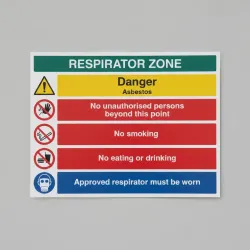
Respirator Zone - Danger - Asbestos - No Unauthorised Persons - No Smoking - Eating or Drinking Safety Signs
Warn individuals about the presence of asbestos, a hazardous material that can cause serious lung diseases when inhaled. The sign clearly communicates that only authorised personnel wearing proper respiratory protection may enter, and that smoking, eating, or drinking is strictly prohibited to prevent contamination and exposure. These signs are particularly important in construction sites, de..
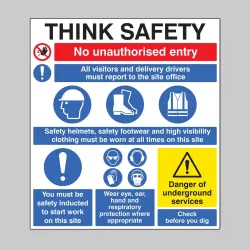
Site Safety - Think Safety - No Unauthorised Entry - Report to Office - PPE - Induction - Underground Services Safety Signs
A Site Safety multi-message board displaying messages like "Think Safety," "No Unauthorised Entry," "Report to Office," "PPE," "Induction," and "Underground Services" is essential for communicating a range of important safety instructions tailored to a construction or industrial site is specific needs. This type of board helps create awareness about key safety protocols and site rules, reinforcing..
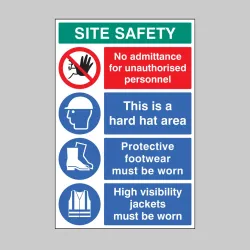
No Admittance - Hard Hat - Footwear - Hi Vis - Multi-Message Site Safety Board Safety Signs
Multi-Message Site Safety Boards are essential for enforcing strict safety protocols at construction sites, industrial facilities, or any hazardous work areas. It clearly communicates that only authorised personnel equipped with the required personal protective equipment, such as hard hats, safety footwear, and high-visibility clothing are allowed entry, helping to prevent unauthorised access and ..
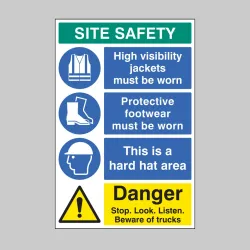
Site Safety - High Visibility - Footwear - Hard Hat - Stop, Look, Listen - Multi-Message Site Safety Board Safety Signs
Multi-Message Site Safety Boards plays a critical role in ensuring safety on construction sites, manufacturing plants, and other hazardous work environments. This sign clearly outlines essential personal protective equipment (PPE) requirements such as high-visibility clothing, safety footwear, and hard hats while also reminding personnel to stop, look, and listen before proceeding, reducing the ri..
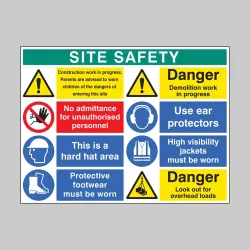
Site Safety - Construction Work - No Admittance - Hard Hat - Footwear - Demolition - Ear Protectors - Hi Vis - Overhead Loads Safety Signs
Using a Site Safety sign with messages like "Construction Work," "No Admittance," "Hard Hat," "Footwear," "Demolition," "Ear Protectors," "Hi Vis," and "Overhead Loads" is essential for clearly communicating the various hazards present on a construction or demolition site. These signs provide immediate visual cues that alert workers and visitors to the dangers they may face, such as falling object..
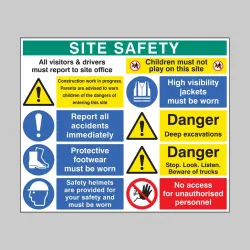
Site Safety - Report to Office - Construction Work - Report Accidents - Footwear - Helmets - No Children - Hi Vis - Excavations - Stop, Look, Listen - No Access Safety Signs
Using a multi-message sign displaying instructions like Report to Office, Construction Work, Report Accidents, Footwear, Helmets, No Children, Hi Vis, Excavations, Stop, Look, Listen, and No Access is critically important on construction sites for several reasons. First, it provides clear, concise communication of essential safety rules and site procedures in one visible location, helping everyone..
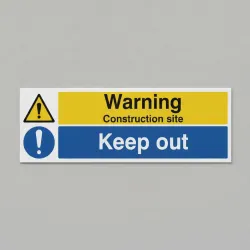
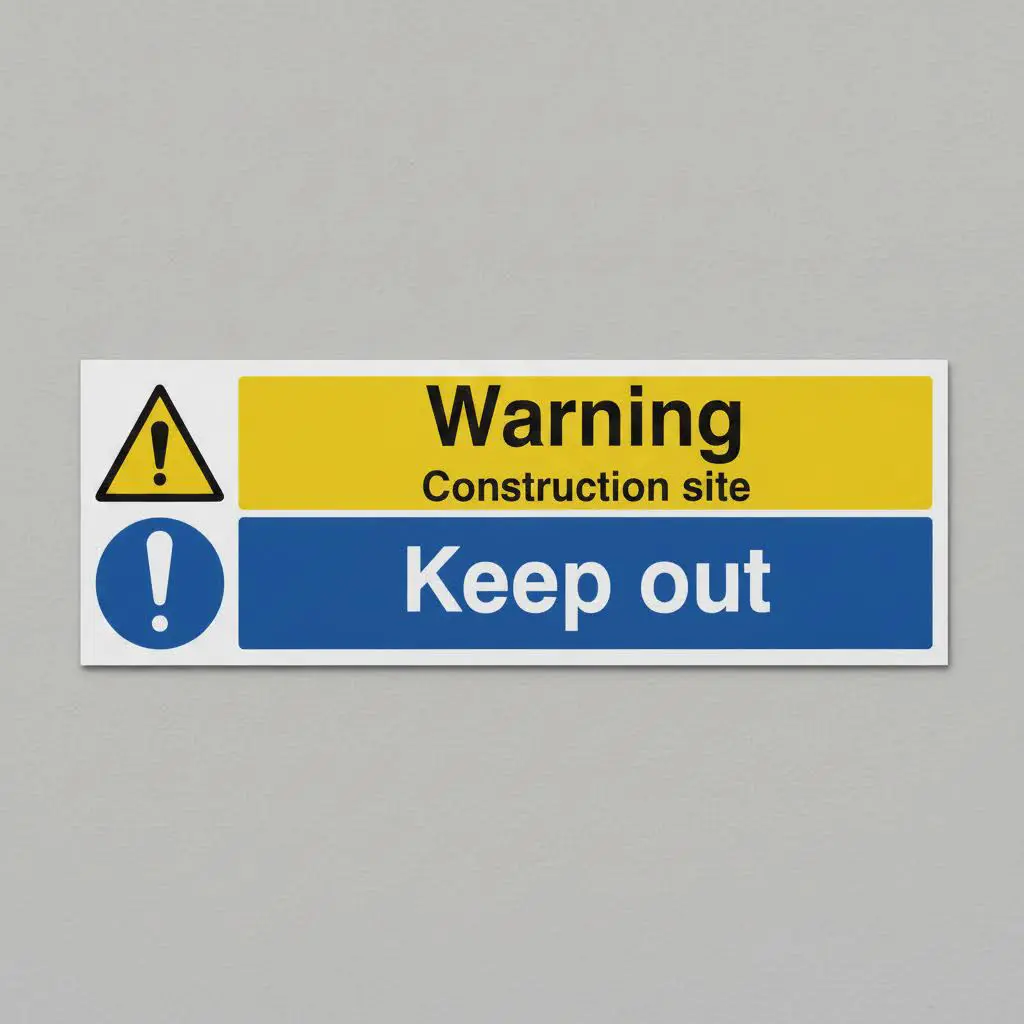
Warning - Construction Site - Keep Out Safety Signs
Alert people that they are approaching a hazardous construction zone and that unauthorised entry is strictly prohibited. Construction sites present numerous risks, including moving machinery, falling materials, uneven ground, open excavations, and other dangers that may not be immediately visible to someone unfamiliar with the work area. The sign is message combines a hazard alert with a clear ins..
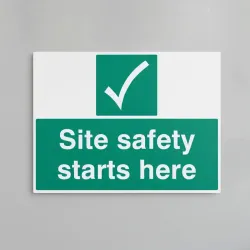
Site Safety Starts Here Safety Signs
Indicate the official entry point to a construction or industrial site where safety rules and protocols come into effect. It serves as a visual reminder that everyone entering the site must follow safety procedures, wear appropriate personal protective equipment, and adhere to site-specific regulations from this point onward. The sign sets the tone for a culture of safety and emphasizes that the r..
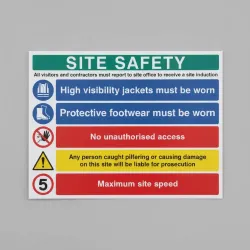
Site Safety - Report to Office - Hi Vis - Footwear - No Access - Liable for Prosecution - 5mph - Multi-Message Site Safety Board Safety Signs
In line with health and safety regulations these multi-purpose construction signs provide information and warning to both the public and contractors alike. Materials Explained Below is a more detailed description of the materials this particular safety sign is available in. Helping you decide which sign option is most suitable for your application. Rigid Plastic: This lightweight, ..