
Emergency Escape Signs FAQs
Written by the Technical Team at Caledonia Signs
Last reviewed: July 2026
Welcome to the Caledonia Signs Emergency Escape Signs Knowledge Centre
This Emergency Escape Safety Sign FAQs page answers the most common questions about escape route signs, fire exit signs, emergency signage requirements, placement, visibility, maintenance, and legal compliance. Whether you are responsible for a new building, updating existing safety measures, carrying out a fire risk assessment, or reviewing your current signage, our expert guidance will help you understand your responsibilities, comply with UK regulations, and ensure your emergency escape signs provide clear direction when they are needed most.
Emergency escape safety signs play a crucial role in helping people find their way to safety during a fire or other emergency. Clear, correctly positioned signage ensures that escape routes, emergency exits, and safe assembly points can be quickly identified, even by people who are unfamiliar with the building. From workplaces and public buildings to schools, healthcare facilities, warehouses, retail premises, hospitality venues, and commercial properties, effective emergency escape signage helps reduce confusion, minimise panic, and support a safe and organised evacuation.
In the UK, emergency escape signs form an essential part of a building's fire safety strategy and are required wherever they are needed to clearly identify escape routes and emergency exits. These signs provide instant visual guidance, helping occupants navigate the quickest and safest route out of a building during an emergency. They also identify important safety features such as emergency exits, refuge points, emergency doors, and assembly points, ensuring everyone knows where to go once they have evacuated the premises.
Why are emergency escape safety signs important?
Emergency escape safety signs are essential for helping people quickly identify the safest route out of a building during a fire or other emergency. They provide clear visual guidance by highlighting escape routes, emergency exits, changes in direction and final exit points, helping to reduce confusion and panic when people need to evacuate quickly. This is especially important in larger or unfamiliar buildings where occupants may not know the layout.Effective emergency escape signage supports a building’s overall fire safety arrangements by ensuring employees, visitors, contractors and members of the public can easily follow the correct evacuation route. Signs should be clearly visible, correctly positioned, well maintained and suitable for the environment in which they are used. In areas where visibility may be reduced, such as during a power failure or smoke-filled conditions, illuminated or photoluminescent signs may help improve visibility.
The need for emergency escape safety signs should be identified through a suitable fire risk assessment, taking into account the building layout, occupancy and potential risks. Using clear, compliant signage that follows recognised standards, such as ISO 7010, helps create a safer environment, supports effective emergency procedures and ensures people can find their way to safety when it matters most.
What are the penalties for inadequate emergency escape signage?
Inadequate emergency escape signage can create serious safety risks by making it harder for people to find safe evacuation routes during a fire or emergency. If a premises does not have suitable signage where it is required, or if signs are missing, damaged, poorly positioned or difficult to see, the responsible person may face enforcement action for failing to meet their fire safety responsibilities.Under UK fire safety legislation, including the Regulatory Reform (Fire Safety) Order 2005, the responsible person must ensure that appropriate fire safety measures are in place based on the findings of a fire risk assessment. Where emergency escape signage is identified as necessary, failure to provide or maintain suitable signs may result in action from enforcing authorities, including the issuing of an Enforcement Notice or Prohibition Notice requiring improvements to be made.
In more serious cases where inadequate signage contributes to a significant risk to life, prosecution may follow, with courts able to impose substantial fines and, for the most serious offences, custodial sentences. Beyond legal penalties, poor emergency escape signage can delay evacuation, increase the risk of injury and expose organisations to reputational damage, disruption and potential civil claims.
Regular fire risk assessments, routine checks and proper maintenance of emergency escape signs help ensure that evacuation routes remain clearly identified, accessible and effective in protecting everyone who uses the building.
How do I choose the right emergency escape safety signs for my building?
Choosing the right emergency escape safety signs starts with understanding the layout of your building, the people who use it and the evacuation routes identified through your fire risk assessment. The correct signage should clearly guide occupants towards a place of safety by identifying escape routes, emergency exits, changes in direction, stairways and final exit points. The type and number of signs required will depend on factors such as the size of the premises, the complexity of the layout, occupancy levels and any specific risks present.When selecting emergency escape signs, consider where people may need additional guidance during an emergency. Signs should be positioned along escape routes, at decision points such as junctions or changes of direction, and above or near emergency exits where they can be easily seen. In larger buildings or areas with limited visibility, illuminated or photoluminescent signs may provide additional support by helping people locate escape routes if normal lighting fails.
Emergency escape safety signs should use clear, recognised symbols and comply with relevant standards, such as ISO 7010, to ensure they are easily understood. They should also be regularly checked to make sure they remain visible, unobstructed and suitable if the building layout or evacuation procedures change. Selecting the right signs and placing them correctly helps support effective emergency procedures, improves occupant safety and ensures your building meets its fire safety responsibilities.
Caledonia Signs Expert Tip: Focus on Consistency
One of the most common issues we encounter is emergency escape routes where replacement signs have been installed over many years, resulting in a mixture of different symbol styles, arrow formats and sign designs throughout the same building. While individual signs may still be visible, inconsistent signage can make escape routes less intuitive to follow during an emergency.
Where practical, we recommend reviewing emergency escape signage as a complete system rather than replacing individual signs in isolation. Using a consistent range of BS EN ISO 7010 compliant signs throughout a building helps improve recognition, creates a more professional appearance and supports clear wayfinding for employees, visitors and contractors.
Whenever building layouts, escape routes or occupancy levels change, it's also good practice to review the associated emergency escape signage to ensure it continues to direct people quickly and safely towards the nearest place of safety.
If you're replacing or upgrading emergency escape route signage, consider whether photoluminescent signage could provide additional visibility during power failures or low-light conditions, particularly along designated escape routes.
Do all emergency escape safety signs need to be photoluminescent (glow in the dark)?
No. Not all emergency escape safety signs need to be photoluminescent. The type of sign required will depend on the building, the escape routes, the lighting conditions and the findings of the fire risk assessment. In many premises, standard illuminated signs or clearly visible non-photoluminescent signs may be suitable, provided they can be easily seen and understood during an emergency.Photoluminescent emergency escape signs, sometimes known as glow-in-the-dark signs, can be particularly useful in areas where visibility may be reduced or where there is a risk of normal lighting failing. These signs absorb light from surrounding sources and continue to emit a visible glow in low-light conditions, helping people identify escape routes, exits and safety information during an emergency. However, they should not be used as a replacement for emergency lighting where emergency lighting is required.
When choosing emergency escape signage, consider the layout of the building, the distance people need to travel to reach safety, the availability of natural or artificial light, and whether signs will remain visible in all expected conditions. Signs should comply with recognised standards, such as ISO 7010, and be correctly positioned, maintained and kept free from obstructions to ensure they remain effective when needed.
What are Running Man Symbols and why are they important?
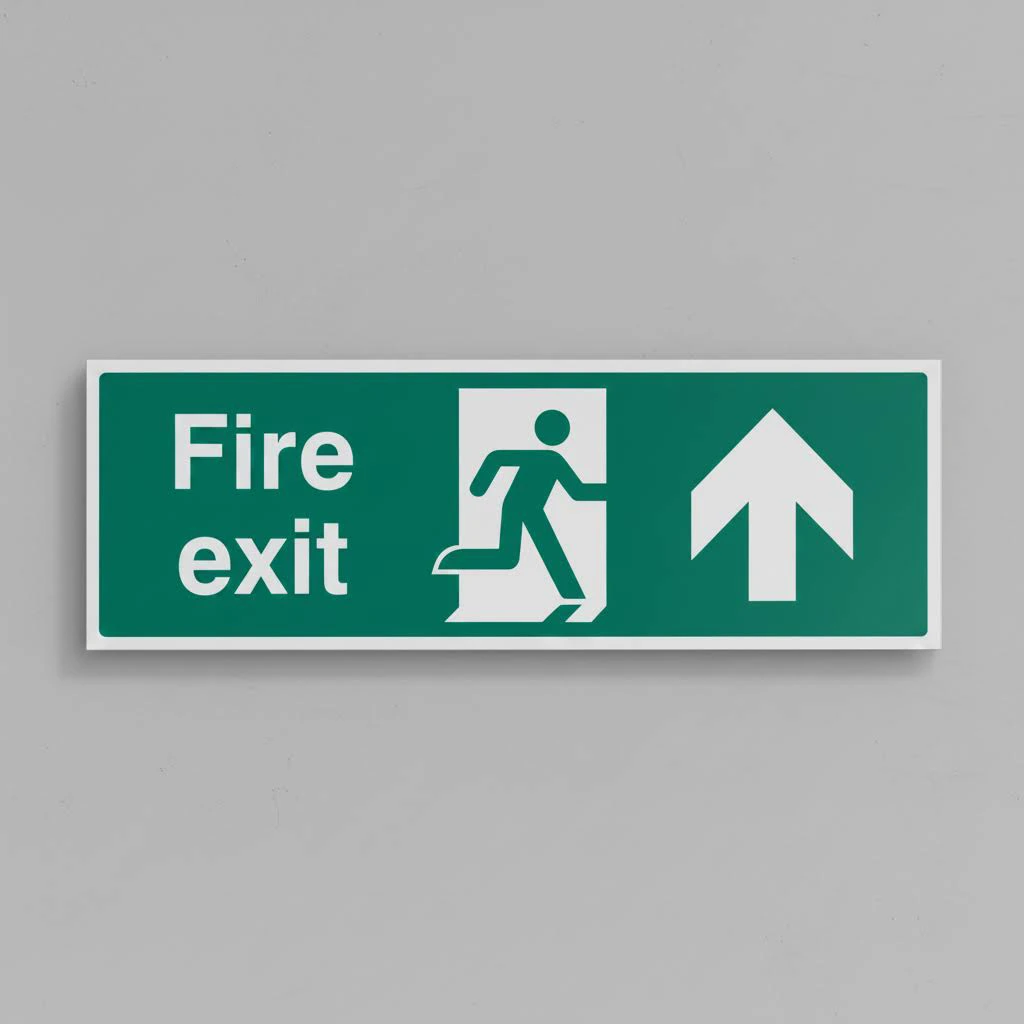
Running Man Symbols are internationally recognised safety symbols used on emergency escape signs to indicate the direction people should follow to reach a safe exit during an emergency. The symbol shows a person running towards an open doorway and is commonly found on fire exit signs, escape route signs and emergency evacuation signage. Its simple, universally understood design helps people quickly identify escape routes, even in unfamiliar buildings or where language barriers may exist.These symbols are important because they provide clear visual guidance during situations where people may need to evacuate quickly, such as a fire or other emergency. By using a consistent symbol system, Running Man signs help reduce confusion, support faster decision-making and make it easier for employees, visitors and members of the public to follow the correct escape route.
Running Man Symbols form part of modern safety sign standards, including ISO 7010, which promotes the use of consistent and easily understood safety symbols worldwide. To remain effective, emergency escape signs featuring the Running Man Symbol should be correctly positioned, clearly visible, well maintained and used alongside suitable directional arrows and other evacuation signage where required. Properly designed and installed escape signs play an important role in supporting fire safety procedures and helping people reach safety.
How high should fire exit signs be mounted?
Fire exit signs should be mounted at a height where they are clearly visible and can be easily recognised by people using the building. There is no single fixed mounting height that applies to every premises, as the correct position will depend on factors such as the building layout, the height of the occupants, the viewing distance, lighting conditions and the findings of the fire risk assessment.In most situations, fire exit signs are positioned above doors, along escape routes or at changes in direction so they can be seen from the greatest practical distance. They should not be hidden by doors, furniture, equipment, decorations or other obstructions. In larger buildings or areas with complex escape routes, additional directional signs may be needed at lower levels or at decision points to ensure people can follow the correct route to safety.
The key requirement is that fire exit signs are clearly visible, legible and provide unambiguous guidance during an emergency. Signs should comply with recognised standards, such as ISO 7010, and should be suitable for the conditions in which they are installed. Regular checks should be carried out to ensure signs remain visible, correctly positioned and effective if the building layout or evacuation arrangements change.
Looking for Safety Signs?
Caledonia Signs is one of the UK's leading trade-only manufacturers of safety signage, supplying an extensive network of distributors throughout the UK and overseas. If you're an end user looking to purchase safety signs, we'd still be delighted to help. Simply contact us with details of your requirements and we'll be happy to recommend a suitable distributor in your area. Interested in becoming a distributor? Contact our team to discuss opening a trade account and gaining access to our full product range, trade pricing and online ordering portal.
There are no products to list in this category.